“I ask myself where the limit of this cruelty lies”: 24J survivor appeals dismissal of his criminal complaint against Spain’s Guardia Civil
A court in Melilla acknowledges that the facts constitute a crime, but closes the case because the perpetrators are unknown, without having investigated. Irídia has lodged an appeal
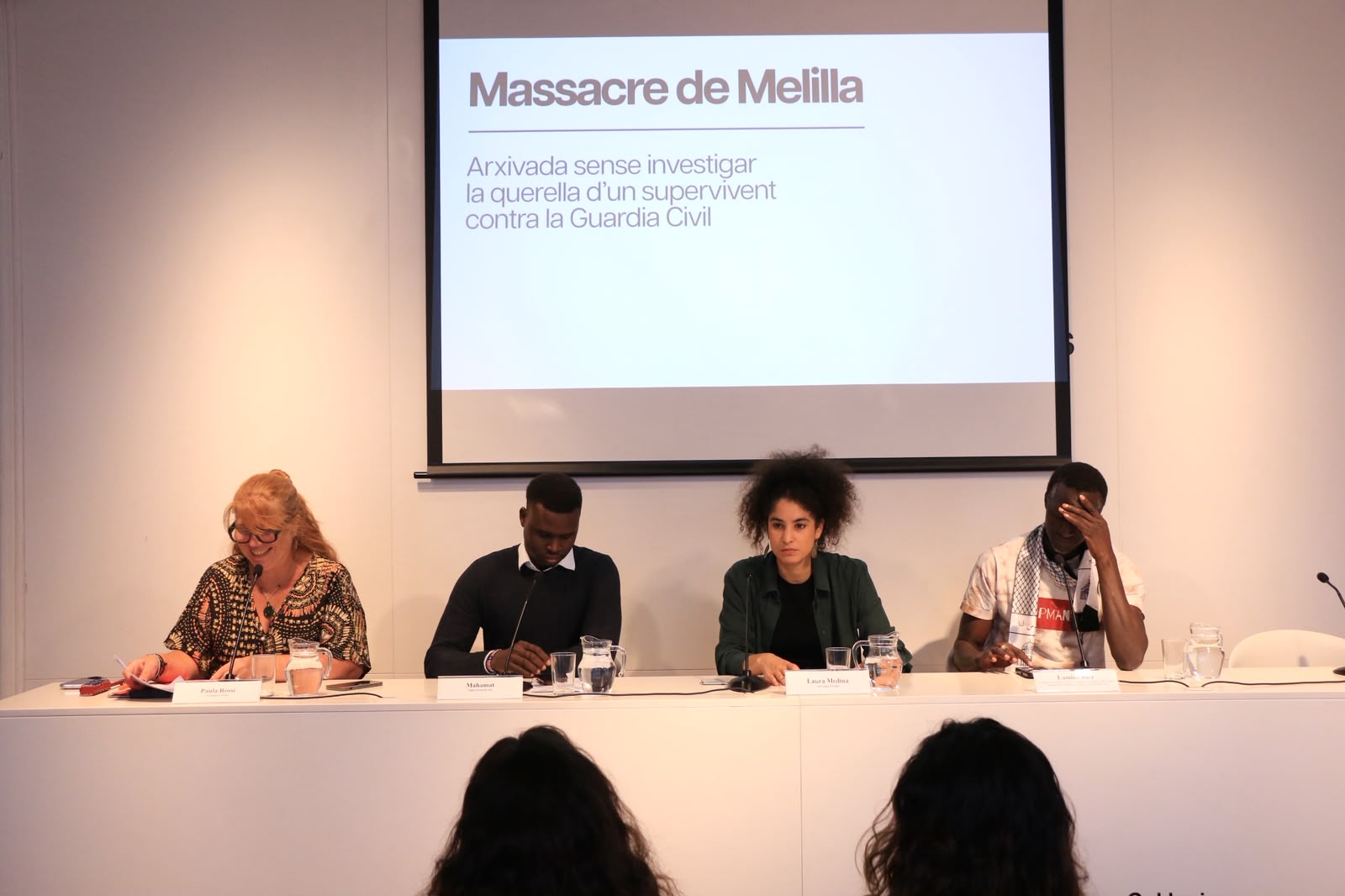
Mahamat, a survivor of the massacre of 24 June 2022 at the Melilla border and co-founder of Refugees in Libya, today denounced the impunity surrounding the events at a press conference held at the Col·legi de Periodistes de Catalunya (Catalan Association of Journalists) in Barcelona. He was joined by Irídia, the European Center for Constitutional and Human Rights (ECCHR), the Popular Union of Street Vendors of Barcelona and the Regularización Ya movement. On 15 October, a court in Melilla provisionally dismissed his criminal complaint: it acknowledges that the facts constitute a crime, but says they cannot be attributed to anyone.
Mahamat explained that, from the way the officers treated him, it seemed he had no right to seek asylum and that all that awaited him was to be beaten and expelled. “That day I lost my dignity, with my hands tied. I ask myself where the limit of this cruelty lies,” he said. He fled Sudan when he was seven years old and travelled through Chad, Libya, Algeria and Morocco before reaching the Melilla border. “We don’t travel for pleasure. We are looking for a safe place.”
Mahamat remembered his best friend, who disappeared that day: “We travelled together and dreamed together. It has left a void in me that makes me wonder when we will get justice.” He also explained that he still receives messages from victims’ families: “They ask me whether they are alive, whether they are in prison. I can’t give them answers. All I know is that many of them fell in front of me.”
“We will not stop until justice and true reparation are delivered, for those who arrived and for those who got stuck,” Mahamat concluded.
What the complaint alleges
Irídia is bringing the case together with its international partners: ECCHR, PRO ASYL and the Digital Freedom Fund (DFF). It filed the criminal complaint on 23 December 2025 against one of the commanders of the operation, who has been identified, and against the officers who intervened. The facts could constitute torture, aggravated bodily harm, failure to assist a person in danger and malfeasance in public office. The complaint also invokes the aggravating circumstances of racist motivation and abuse of their position as law enforcement officers.
Mahamat told the officers that he wanted to seek asylum and that he had refugee status recognised by UNHCR. While he was on the ground, detained and following orders, an officer struck him on the head with a baton, causing a traumatic brain injury and loss of consciousness. He was then kept handcuffed for hours among injured and dead people and forcibly returned to Morocco without any procedure. Officers also prevented the Red Cross from treating him. An expert report by the Sira Centre, carried out in line with the Istanbul Protocol, concludes that his account is highly consistent.
A dismissal without investigation
The court took five months to open proceedings. It has now dismissed the case without ordering any of the investigative measures requested to identify the officers, such as the duty rosters or footage from the border cameras, the helicopter and the drone. Nor has it taken a statement from the victim or responded to the request to join the case to the ongoing investigation into the events of 24J.
“The case is being dismissed because the perpetrator is unknown, without any investigation having been carried out to identify them. This is a high-tech border built to monitor migrants, but it stops working when torture needs to be investigated,” said Laura Medina, a lawyer at Irídia. Medina also criticised the Public Prosecutor’s Office, which is demanding that the victim provide evidence that the officers themselves prevented him from obtaining: “Once again, those who should have protected the victim have turned their backs on him.” The European Court of Human Rights has ruled against Spain 14 times for violating the prohibition of torture, 13 of them for failing to conduct an effective investigation. “Dismissing a case without investigating it guarantees impunity,” Medina concluded.
Impunity beyond Melilla
“International law is very clear on the obligation to effectively investigate acts of torture. Dismissing this investigation is not only a breach of that obligation, but also a deliberate attempt to maintain impunity for State forces and to normalise violence against migrants at Spain’s borders,” said Silvia Rojas-Castro of ECCHR. “That is why we are calling on the Spanish State to shed light on the events of 24J, including the fate of those who died or disappeared, and to hold those responsible for this violence to account.”
Lamine Sarr, spokesperson for the Sindicat de Manters (Street Vendors’ Union) and Regularización Ya, placed the case in the context of structural racism: “When it comes to migrants, all too often there are no rigorous investigations and no proper follow-up of cases. No one should be above the law: neither the police nor politicians.” Sarr added: “We are human beings. We are not disposable objects. We are people.”
The impact of impunity
“Violence does not end when the beatings end. It continues through its impacts and through the State’s inaction,” said Paula Rossi, psychologist and migration and border lead at Irídia. Rossi explained that dismissing a case without investigating it tells the victim that their account does not matter, and turns the search for justice into a new experience of being left unprotected. “Impunity in border contexts is not a failure of the system: it is the system.” On 24 June 2022, the crackdown by Moroccan and Spanish security forces at the Melilla border left at least 37 people dead and 76 missing, and around 470 people were summarily returned to Morocco. More than four years later, no one has been held accountable. With the appeal, Irídia is asking for the dismissal to be overturned and for the case to be joined to the ongoing investigation into the events of 24J.
Watch the press conference: YouTube